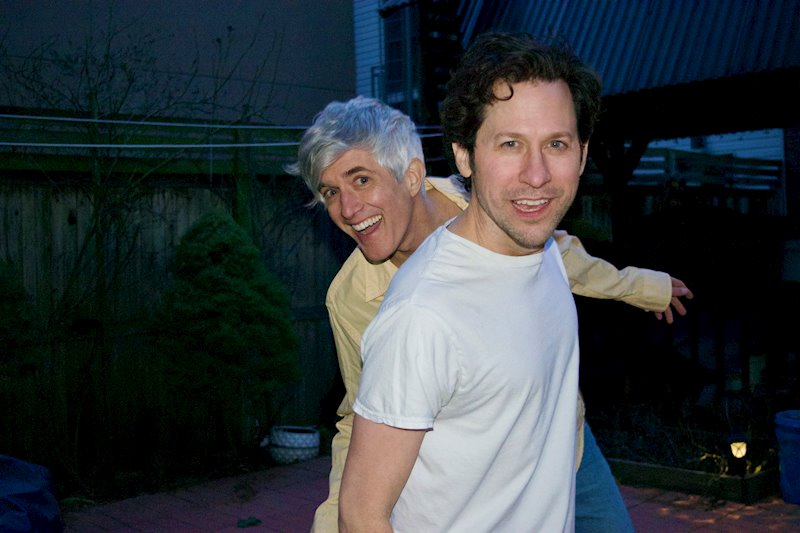
For over two decades, We Are Scientists have quietly built one of indie rock’s most enduring careers, evolving their sound while keeping their signature wit, hooks, and heart intact. With their ninth studio album Qualifying Miles came out July 18 via Grönland Records, founding members Keith Murray and Chris Cain return to a raw, guitar-driven sound rooted in ‘90s rock nostalgia, reflecting on time, memory, and loss. As they celebrate the 20th anniversary of their breakout debut and prepare for an ambitious international tour, we caught up with the band to talk evolution, introspection, and the art of writing songs just for the joy of it.
Q: In your opinion, what are the essential qualities that make a “good songwriter”?
“Greatness” is such an ineffable and subjective quality, also probably a ludicrous standard to even try to pinpoint, I don’t really imagine any definitive attributes can be applied. I think the only element that I’m really willing to go out on a limb and say is a mandate for great songwriting is idiosyncrasy. If a songwriter is consistently able to capture their own voice or viewpoint or ethos or whatever, they’re getting it right. I think Alex Turner of Arctic Monkeys, who has an utterly poetic and inimitable way with language, is great, and I think Wesley Willis, whose songs were about as terse and basic and direct as you could possibly find, was also great. Eddie Argos is a great songwriter because you can listen to Art Brut’s records and come to know Eddie about as well as his personal friends do - he pretty much spells out who he is and what he thinks about in plain English, right there in his lyrics. Phoebe Bridgers, on the other hand, is usually more opaque and allusive, but still manages to communicate herself in her songs. Those early Weezer records were great because they really painted a portrait of Rivers Cuomo as a person - a weird, perhaps unlikeable person, sure. The later albums are, I think, less great mainly because it felt like he’d begun to intentionally remove his personal quirks and peccadillos, which were fundamental to the success of those earlier songs.
So, I don’t know. I guess it’s a pretty reductive, obvious answer, but I’d just say that it’s the writer’s voice that makes them great - more that they *have* a voice rather than any specific qualities that voice might possess.
Q: What is the basis for writing attention-grabbing music in this day and age?
Oh, god, I don’t know. I guess “attention-grabbing” is a different mandate from “attention-deserving.” I guess if you’re trying to grab attention it’s best to put the chorus right up at the top of the song? Keep it short and minimal. It’s probably fairly helpful if you’ve had a long string of celebrity exes that you don’t mind publicly calling out in your songs?
Q: Can you pinpoint some specific songs and songwriters that changed the way you write music?
I want to say The Beatles, who, yeah, are probably the most boring possible answer to this question, but I’m thinking of them mainly because their constant churn of songs is particularly inspiring to me. Most people look at their catalogue and marvel at the dense mass of great tunes, but I’m more inspired by the sheer volume of it. Those dudes just churned out the songs, and thank god they did manage to write so many incredible bangers, because, frankly, there’s also a whole lot of filler or on those records. But I love that. I honestly enjoy feeling that to go through their catalogue is to kind of watch a timeline of three great songwriters (sorry, Ringo) just busting their asses for ten years and pretty much just airing out all of their laundry, both clean and dirty.
Q: Do you find it hard to be inspired by your peers? Can you name any new artists you find inspiring?
I guess I very rarely feel specifically inspired by my peers. My reaction is usually more “competitive” than “inspired,” like, “Oh, this is what they’ve released? I can do better than that!” I do find Arctic Monkeys’ consistent push to explore new modes pretty inspiring , and those middle couple of The 1975 records where they were really experimenting with production were pretty exciting to me. Charli XCX’s album Crash was a pretty big inspiration to try to find ways to subvert straightforward radio pop.
In terms of new artists? Uh, Turnstile makes me want to write big dumb (in the best way) rock songs. Jean Dawson’s bedroom recordings with a kitchen-sink approach to songwriting are very cool. Wet Leg gets me excited about straight-up indie rock, and The Last Dinner Party gets me excited about slightly more baroque indie rock.
Q: For your new album, what inspired the lyrical content, album title, and overall vibe?
For the most part, the songs we collected for this record were all drenched in nostalgia. A lot of the lyrics ruminate on relationships long-past — not romantic relationships, generally. More like old friends who simply faed out of my life at some point, for no apparent reason, or co-workers who were once part of my daily life but who I hadn’t even thought about for many years. I’m not sure why I went through this specific period of being so interested in those sorts of relationships, but the idea that these people who were once so close to me had unceremoniously just become little more than phantoms was intriguing. It also got us thinking a lot about the music of our youths - of high school and college, when it seems like your friendships are iron-clad and all consuming. So, yeah, the album Qualifying Miles is all about raking through that amassed catalogue of accrued life experience and trying to square how these people who once seemed like an inextricable part of my life quietly faded from it without much thought at all.
Q: Do you find that you ruminate over writing songs and hold on to them for a long time before including them on a record? Or do you prefer to write them, release them, and be done with them? Do you ever revisit old material to do a re-write or once it’s done it’s done?
I absolutely prefer to write, record, and release a song as quickly as possible. I find that ruminating over a song usually strips the vitality from it. Lyrics that I labor over usually feel overly fussy and less “true” than those I write in the heat of the moment. I tend to prefer my gut songwriting instincts over analytical choices, and I often find that the more time I have to tinker and rewrite, the less exciting the results feel. I’d usually rather write a song in a rush and then simply throw it away and write a new one, rather than continue to hone the work and try to bend it to my will.
Q: Were there any lessons you learned in the writing and recording process for your current release that you will take with you into your next project?
I think - maybe through the wisdom of age or possibly simply the amassing of a big catalogue of songs - that I’m less and less precious about individual songs. I don’t mean that I can’t consider the songs themselves precious, but just that I’m more willing to let them go. There were a few songs that we wrote for Qualifying Miles that are among my favorite We Are Scientists songs, but either because Chris didn’t share my particular enthusiasm for them or because they didn’t fit the overall stylistic rubric we landed on for the record, they were tossed. Fifteen years ago, I would have been gutted by their expulsion, but the album as it is didn’t want them, and it’s better for their exclusion.