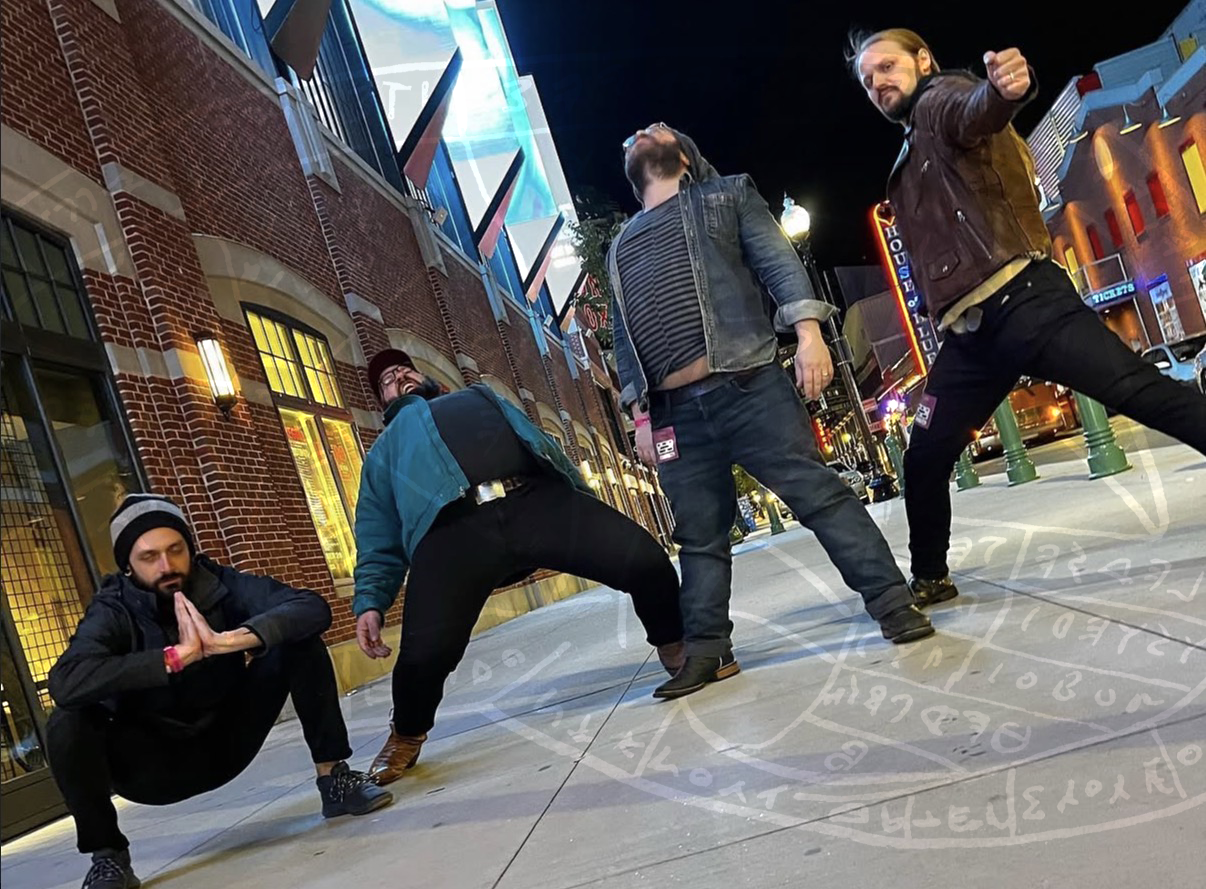
Clamb has never been particularly interested in playing it safe. Rooted in improvisation, progressive rock, jazz fusion, and experimental music, the Boston-based quartet has built its identity around creative freedom, collective expression, and the willingness to embrace uncertainty. With Quiche Mountain, the band continues to explore the possibilities of its expanded four-piece lineup while challenging conventional ideas about songwriting, perfection, and what makes a musical performance meaningful. We caught up with synthesizer player Peter Danilchuk to talk about the band's creative philosophy, the importance of spontaneity, finding an identity through improvisation, navigating today's music industry, and the artists and recordings that continue to inspire them.
1. Clamb's philosophy seems to challenge the pressure to make music that is polished, immediately accessible, or designed to satisfy an algorithm. What does creative freedom mean to you in practical terms? How do you recognize when you're making music for yourselves rather than responding to expectations about what music should be?
Peter Danilchuk (synthesizer): It helps that first and foremost we are making this art for its own sake. The first thing we hope comes across to a listener is the understanding we are trying to experience the raw joy of creation and making something as a collective effort. When we keep that in the forefront of our minds as we do this, it helps answer a lot of the questions that a composer might ask, such as “is this section too long?” or “does this have a satisfying narrative arc?” or “does this have a singable melody that will stick in someone’s head?” Our focus is really based on how this music actually feels to play, as the players, so that to the listener it comes across as comfortable, like the four of us are in our element and creating music in a relaxed, caring, and joyful way and are expressing ourselves to the fullest extent that we can. If we were writing tightly arranged material I’m sure we would find ways to achieve a similar effect since we all share that common desire, but this specific type of music making lends well to allowing us a great deal of possibility for expression with as few barriers as possible to that goal.
2. Instrumental bands don't have lyrics to establish a story or tell listeners what to feel. What makes a piece of instrumental music compelling enough to hold someone's attention from beginning to end? Do you think in terms of tension, release, repetition, surprise, atmosphere, or something less easily defined?
P: We’ve stripped away so much of the ethos of standard songwriting in this music that it should be seen as more of a musical conversation than anything else. So in our case, the conversation should feel open and like each instrument has sonic space to exist, and the four players should be able to take turns playing lead and support, and play with contrast and atmosphere to let the overall texture feel like something the listener’s ear can explore. Tension and release are important but we don’t always have song structures to force us into those moments—often we need to find spaces in our performance where we can utilize tension and release to create sonic interest. But at the same time we are big proponents of letting repetition develop on its own and not require tension and release at all. Or rather, inside of a super-repetitive moment, even a small change can be perceived as much bigger because all the other choices have been so pared down. And with playing improvised music like this, especially without vocals, a huge part of bringing it to an audience has to do with connecting directly with the audience. Instrumental or vocal, I think we’ve all been bored by bands staring at their shoes the whole night. Locking eyes with each other and audiences and demonstrating physically that we are in the same moment as them goes a long way to humanizing this music and letting audiences into the atmosphere we’re creating. So it’s never been about fireworks, it’s about being present.
3. Your influences include artists as different as James Brown, Alice Coltrane, Cluster, and Harmonia. Can you identify specific recordings that fundamentally changed the way you hear rhythm, harmony, texture, or the relationship between musicians? What did those records teach you that you still carry into the rehearsal room?
P: I can say I learned a lot from Brian Eno, especially Another Green World, and learned a lot about composition from the way he arranged his short and mid-length pieces on that album in particular. I’d say the four of us all really enjoy Mahavishnu Orchestra for their emotional intensity and advanced harmony, and I know that hearing those early era jazz fusion records as a teenager pushed me into new places as a young rock and metal listener. It’s no surprise I decided to make instrumental music considering those influences. Listening to the West German krautrock bands from the 70s was great as a young synthesizer enthusiast, to hear how these conservatory students and young artists were using this brand new technology to build on their existing techniques as avant-garde musicians of their era and I still carry a lot of those primitive synthesizer sounds and their uses into this music 50 years later.
4. Experimental music often depends on a willingness to make decisions before knowing whether they'll work. How comfortable are you with uncertainty as musicians? Does that willingness come naturally to everyone in the band, or have you had to learn to trust one another when a musical idea seems to be going nowhere?
P: It’s that uncertainty that drives the whole thing. We’re not thinking whether or not something will work, because sometimes you can just keep playing something until it ends up working. Patience is a big part of making music like this since it isn’t about narrative arcs or big moments or technical flashiness. Patience, and the confidence to stay patient. It’s about painting a picture as a rhythm section and letting melody shine through when the rhythmic aspect is functioning the way it should. The approach to this music is always pretty calm and relaxed, no matter the tempo or how close together the notes end up being. And I consider the group of us very lucky that we all have been aligned on that mission since the beginning. The job is pretty clear in this band that we’re expected to go into playing Clamb ready to listen and respond, and not wait around for a composed moment to take a song to a new dynamic level.
5. There is a particular tension between improvisation and developing a recognizable band identity. How do you keep Clamb sounding like Clamb without falling into familiar habits? Do recurring grooves, sounds, and interactions emerge naturally, or do you sometimes deliberately push yourselves away from musical territory that has become too comfortable?
P: I don’t think there’s much of a tension at all between improvising and having a band sound. In fact I think it’s easier because we don’t have strict guidelines keeping us from sounding exactly like ourselves. What the listener gets is a pretty unfiltered representation of what the four of us sound like when we start playing, without one person’s compositional voice forcing a player to act differently to serve the piece of music. Our music, no matter who brings the initial seed idea, only exists thanks to the interplay between the group, making choices on our respective instruments and trusting the others to do the same. To be honest if we were capable of writing something that sounded even more like Clamb I think we’d have to try it! But what usually happens is we’ll start playing with an idea and we will find the way the Clamb sound works its way into whatever we’re playing. And in that way it takes a light gardener’s touch rather than doing any sort of architecture, to use a forced metaphor, to achieve the sort of feeling we want our music to have.
6. The idea of music as a snapshot of a particular moment runs through your earlier releases. When you listen back to an old recording, do you hear a finished piece of work, a record of who you were at that time, or simply a starting point for something that could evolve further? What makes a recording feel complete to you?
P: Learning to see every unique performance as a finished work has been part of the perspective shift this music requires. This artistic project basically requires that there is no fixed final form of anything, but rather asks that the continuous playing of something constitute its existence. I won’t say we’re playing jazz in any way, nor do we really like that word in general, but this is one feature Clamb shares with that music, which is that the interpretation is the art form itself, rather than iterations on a finished, “perfect”, or ur-version of any one piece of music. When we are rehearsing or in the studio, we basically call something finished when we hit a point where we can say to each other, “This next take wouldn’t be better—at this point if we played it again, it would just be different.” And that’s usually when we know to stop workshopping something and move on, and let live performance dictate the rest. Because those “different” versions are the ones we want to come out onstage, not behind closed doors.
7. Your new guitar player changes the musical equation, but the arrival of another musician also changes the social dynamic of a band. Has the new lineup challenged any assumptions you had about how Clamb works? Has someone else's musical vocabulary encouraged the rest of you to approach your instruments differently?
P: We are so lucky to have Sam in the band now. He already knew the ethos of this music, and we’ve been friends and bandmates in other groups for a long time so we already shared a sense of humor as well as comparable musical tastes. Getting him involved has amplified everything we do. Our dynamic range has gotten wider, having a fourth musician of his musicality gives us so much more to work with in an improvisational and arrangement setting, plus he is right there with us in the way we want to make each other and the audience laugh and feel joy when we are playing music.
8. In a band built around improvisation, how do you negotiate the balance between individual expression and collective responsibility? Is there a point where a musician needs to stop developing an idea and make room for someone else, or does that kind of interaction happen intuitively?
P: It’s a constant marriage of the two things. Individual expression includes playing rests and sitting out. Collective responsibility sometimes means one person signals a change, or steps out of the ongoing texture and pulls everyone else along with them. There isn’t really a point where someone needs to stop developing an idea, because that decision should be respected and supported by everyone else. And that’s where trust comes into this, because if there was a band with one member who would egregiously overplay or try too hard to always be mixing it up, then the rest of the musicians might not trust that person to take the lead anymore. We’ve built up a level of trust with each other where no matter what someone tries to pull onstage, we want to support and highlight it to give them the best version of whatever thing they’re doing.
9. The music industry increasingly encourages musicians to think in terms of constant output, online visibility, and content creation. Clamb's stated philosophy pushes against that mindset. How do you navigate the realities of releasing music and reaching an audience while protecting the exploratory spirit that makes the band worthwhile to you?
P: We can only do so much when every outlet to promote our music is asking us to pay like crazy to get above the noise and reach new audiences. But none of this changes the fact that there’s no substitute to actually being on the local scene and being at shows, connecting with real people in real life and taking the band to new places and meeting new audiences and musicians. We’re so lucky to be in Boston where the local scene is talented and supportive, since none of this could ever happen in a vacuum. We’re presenting our art to the world to the best of our ability and with the means we have available to us, so anyone who decides it’s worth anything to them is someone we’d like to meet. And people we meet on tour are always so supportive and are right there with us no matter where we take our live set. So that just confirms for me that the priority for a gigging band like us needs to always be playing shows of a high quality, and show gratitude to everybody who chooses to give us their attention when we do. And having a record that's a strong representation of that live experience can always help warm up potential new fans to the musical world we're trying to inhabit.
10. Experimental music can be difficult to categorize, which can be creatively liberating but sometimes makes it harder for new listeners to discover a band. Do you think about who your audience might be when you're making music? Have you found that listeners from seemingly unrelated musical worlds connect with Clamb for entirely different reasons?
P: “Experimental” is certainly an approach, but thankfully not a genre unto itself. When it comes down to it we are an improvising rock band, and I think using that language helps convey to audiences that we’ve got a standard rock band instrumentation and draw from a certain type of music, and the difference is that we allow basic structural elements like how long a section is, or how a groove gets interpreted, to be open to interpretation based on how we are feeling. Anything else we sound like fits on top of that. I don’t think any fan of 70s rock or modern psychedelic rock, or jazz fusion of any era would find what we’re doing to be terribly foreign, especially if they already have an ear for instrumental bands. That being said, this music doesn’t have to be for everybody, nor is any art able to accomplish that. This is for people who want to be a little baffled, laugh a little, listen to some instrumental playing that might make them feel inspired, and to feel like they’re part of a bigger circle of people who want something out of music beyond it sounding safe and aimed at the widest, or youngest, common denominator.
11. When you choose the ten tracks for a playlist of music that inspires Clamb, what would you want that collection to communicate about the band that a press release or album description couldn't? Would the playlist represent the music you consciously draw from, the music you listen to outside the band, or the unexpected connections between those two worlds?
P: These ten tracks are a really good mix of things we've always liked, that have inspired the band since the beginning, and some more specific tracks that have contributed to Quiche Mountain. I feel like anyone who listens through these ten tracks would have a decent understanding of where we'd be coming from. There's a pretty good confluence of rock, jazz fusion, groove music, and quite a bit of repetitive vibing. And there's a good mix of things from back in the 70s going forward to today that I think accurately represents what we listen to individually.
Our ten track playlist:
1. “Trite” by Kneebody. Real cool use of polyrhythms and wild phrasing on the drums. -Josh Merhar (drums)
2. “Fred” by Tony Williams. I just like the whole vibe. Def inspired some of the stuff I play specifically on Quiche Mountain and Night Hogs -JM
3. "Hollywood" by Cluster. Big inspiration on us for its shifting and cycling melodic phrases, and for some of the synthesizer timbres I use in this band. -Peter Danilchuk (synthesizer)
4. "Mess Mend" by Horse Lords. One of the best bands on the scene making the type of music they make, using repetition and gradual change to transport the listener. -PD
5. "Maahnt" by Magma. In terms of strong artistic statements almost nobody does it like Magma, and they can transmit power and jubilance and any emotion they want with such masterful directness. And it's sung in a made up language so the whole world can enjoy it equally. They've got an enormous body of work to appreciate, but this song has a specific charm to it, and is somehow able to be a little bit ridiculous and yet still rock in a completely serious way. Which we've really tried to take to heart as Clamb. -PD
6. "Actual Proof" by Herbie Hancock. This is the gold standard for how tightly and responsively a band can play as a unit. It feels like a constant wave of notes at times, but there is still so much room between the players. Capturing this sort of group elasticity was a big focus for us on tunes like Emerge! O, Citroid that really relies on full-band cues to get its point across. -PD
7. "Nautilus" by Anna Meredith. A beautifully unfolding storm of repetitive chords that makes you feel like you're in a time loop, with a cool metric modulation in the second half that makes you re-evaluate the first half. I don't think our closing track Hail would exist without having experienced the unrelenting nature of this piece. -PD
8. "Dark Fish" by Club d'Elf. If there is one Boston band who sets the tone for high-level improvisation in our scene, it'd be Club d'Elf. A lot of our peers in the scene came up going to their Friday residency at the Lizard Lounge in Cambridge. They've been moving the needle for free flowing improvised music since the 90s and they have only gotten better and scarier over the years. -PD
9. “Never In My Life” by Mountain. The balls to the wall energy and attitude on the Mountain tune are off the charts. I think of stuff like that for the intensity of something like Land Breath or Hail. It has such a great riff, and I’ve always loved the album art. -Sam Crawford (guitar)
10. “Mondo” by Tom Scott and the L. A. Express. “Mondo” has a really cool 70s keyboard line and the harmony has a mysterious quality to it that’s kinda spooky. It’s one of the darker tunes on the record. As a bonus, it features Robben Ford, my favorite electric blues guitar player. I like how that band and this tune in particular drew out his fusion side. -SC
12. Looking ahead, is there a musical idea you've wanted to explore but haven't yet found the right opportunity to pursue? With the addition of guitar and the continued evolution of the band's sound, what would excite you most about the next phase of Clamb—even if you have no idea what the finished music will sound like yet?
P: We’ve always prioritized keeping our ideas relatively small in this band. Even though the performance of our pieces can occasionally extend to 5 or 7 minutes, we’ve always valued having short bursts of musical ideas and not creating long rambling pieces that run the risk of not going anywhere. I’m ready to explore longer-form composition and to try to create a piece that we could play for a full 20 minutes, take up the whole side of a record, to see if we can do it. No matter what we play, I trust that the more we continue down this path, the more our musical connections will deepen and uncover all sorts of hidden ideas that may have already been nestled away in the recesses of our minds. It calls to mind one of my favorite mantras that we say to our fans: "You ripple with energy—you always have." So we've just got to tap into what we're already brimming with and let the music do its work.
https://www.instagram.com/clambgramb