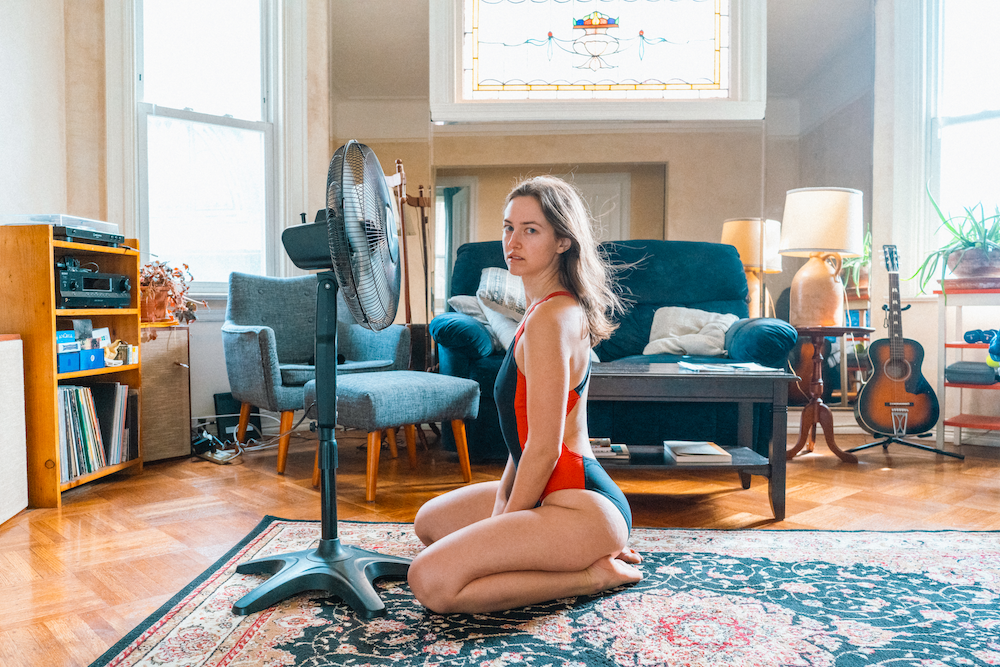
Brooklyn-based songwriter Camille Schmidt has just dropped her debut EP, Good Person. The six-track collection was produced by Phil Weinrobe, known for his work with Adrianne Lenker and Tomberlin. In May 2023, Schmidt, Weinrobe, and her band—Brooklyn guitarist Sam Talmadge, drummer Pele Greenberg, and LA bassist Eli Heath—recorded at Weinrobe’s Sugar Mountain studio. Weinrobe’s unconventional method involved recording songs live without pre-planning or allowing the band to listen back, capturing an authentic and raw sound. The EP explores Schmidt’s personal struggles with shame and perfectionism, reflecting on her past and her hopes for the future. Good Person is Schmidt’s first official release, and she continues to perform with her band across NYC.
Q: In your opinion, what are the essential qualities that make a “good songwriter”?
Honesty is the biggest. About yourself, your feelings, about what you’re seeing around you. Also important: an eye for the minutiae of the world, the banal going on around you, the experiences of other people and how these might differ from yours. Also the ability to stay soft, sensitive, porous, in spite of how desensitizing this experience in the Anthropocene can be.
Q: What is the basis for writing attention-grabbing music in this day and age?
I can speak for what grabs my attention. And that is music that is honest and authentic. Music that, to use a Kendrick-ism, is like hey, “watch my soul speak.” There’s this viral TikTok in which a woman says something along the lines of “say the weird thing, that’s what people are craving.” And it’s what I’m craving for sure. We’ve been fed so much propaganda through different forms of media that I think we, as a culture, are just starting to unpack. And it’s deeply disturbing and also amazing to see how easy it is to just regurgitate that propaganda via our arts. And by propaganda I even mean the way we have learned to view ourselves, to safely express our feelings (as women, queer people, BIPOC), to talk about interpersonal and socio-economic issues in our art. It’s so exciting when an artist is aware of that and decides to go deeper. When an artist looks at the self they’ve learned to present to the world, looks at the world they’ve learned to accept, and then asks “What’s beneath this?”
Q: Can you pinpoint some specific songs and songwriters that changed the way you write music?
Fiona Apple. John Prine. Psychic Temple. Conor Oberst and his work with Bright Eyes; Oberst’s 12 minute song “Let’s Not Shit Ourselves (To Love and be Loved)” is a favorite of mine. He has this incredible power in which he is able to hold the complexity of the world - both pain and beauty - in his lyrics. He goes from describing a mother penning a shopping list, to a coroner standing beneath a wooden cross, to his own experience to waking up in a hospital with his tubes all tangled, to saying a big fuck you to George Bush and his speechwriters, to then remembering this lovely melody he (Oberst) once heard that made him feel grateful to be a part of the mystery, to love and be loved. That kind of broadness, the range that feels like it sucks in the whole world, excites me.
Q: Do you find it hard to be inspired by artists that are younger than you, or are you motivated by their energy? Can you name any new artists you find inspiring?
Younger than me? I’m the youngest person who has ever lived.
Contemporary artists I find inspiring: Chappell Roan’s finger is on the pulse right now; I am rooting her on from afar. Every one of Adrianne Lenker’s songs. Allegra Krieger. Dora Jar. Alena Spanger. Samia. Enumclaw. Nourished by Time. Squirrel Flower. Angie McMahon. Noa Jamir. Glaive. Bladee. Eliza Edens. 100 Gecs. Greg Mendez. Lily Talmers. Medium Build. Elise Leavy. Hemlock. Palehound. Dylan Rodrigue. Miya Folick. Eliza Elliott. Blondshell. I’m so lucky to share this lifetime with so many beautiful friends and artists who are making the fucking best music.
Q: For Good Person, what inspired the lyrical content, EP title, and overall vibe?
The vibe, the lyrics, the melodies, all of it was a response to feelings of shame I’d been harboring for a long time. Also a positive reaction to leaving an awful relationship, coming out as queer. The EP title is taken from a lyric in the song “Bumblebee Drinks Lavender” where I talk about how if I wasn’t “addicted to the idea of god, tree, friend, mother, and good person” I could let myself love and be loved all the way through.” The EP, to a certain degree, is about taking off the masks I was wearing. The masks I was forcing onto the people and places and ideas around me. That were sort of foreshortening my relationships to these people and things. In retrospect, I see how I wanted to examine the idea of what a “good person” really is. And see if I could find a way to make it a container for the full complexity of human emotions. A different thing than I’d been taught it was.
Q: Do you find that you ruminate over writing songs and hold on to them for a long time before including them on a record? Or do you prefer to write them, release them, and be done with them? Do you ever revisit old material to do a re-write or once it’s done it’s done?
I did that for this EP. Held on to maybe 500 songs I’d written in the years leading up to recording it. That’s not something I’m interested in doing anymore. I want to write and then release pretty quickly after. I think often the songs I’m writing, especially some of the new ones that will be on my upcoming album, are directly in response not only to things happening in my personal life, but also to things happening in the world. And that feels important to get out. As artists we’re locked into a call-response song with the world. Sometimes the world is calling and we’re responding; sometimes we’re calling and the world is responding. This feels like an important process to keep fluid, to keep alive.
I barely ever revisit old material. I know pretty instinctually when I’m writing a song whether or not it’s gonna be one that sticks around. And usually those come out in one go. Sometimes I’m wrong, sometimes a song surprises me, every once and a while a song takes longer. But for the most part there’s so much coming out of me musically right now that I don’t feel the need to hold onto old material, I’d rather wait and sit in the void until a new thing taps on the door of my mind and asks to be let out.
Q: Were there any lessons you learned in the writing and recording process for your current release that you will take with you into your next project?
Yeah definitely. That it feels good to be vulnerable. To just be honest. Even if it feels scary at first. That when you think you sound bad, look ugly, whatever, you’ll look back on whatever you sounded like, whatever you actually looked like, with a whole lot of love for that past self.
I learned a lot from making the EP. I just finished recording an album a few days ago. With this album, I took a whole new approach. Good Person was recorded mostly live, no headphones, my band and I playing together in a small space, the producer not letting us hear what we sounded like. The new album I just recorded is done the opposite. We recorded in a way that’s given me a lot of control to try many things out, see what I like, what I don’t, to co-produce it really. I think it’s great to let the pendulum swing one way after it swings the other. This new album is continuing my experiment in honesty. It’s by far the most vulnerable thing I’ve ever made. I’m excited for the world to hear it.